
Edexcel IAL January 2024 P4 (WMA14/01) Q7 Integration by Substitution, Trigonometric Identities, Volume of Revolution
(a) Using the substitution \( u = 4x + 2 \sin 2x \), or otherwise, show that
\[\int_{0}^{\pi} e^{4x+2 \sin 2x} \cos^2 x dx = \frac{1}{8} (e^{2\pi} – 1)\]
(5)
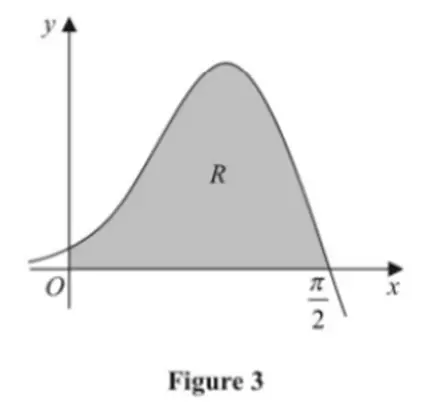
The curve shown in Figure 3, has equation
\[y = 6e^{2x+\sin 2x} \cos x\]
The region \( R \), shown shaded in Figure 3, is bounded by the positive x-axis, the positive y-axis and the curve.
The region \( R \) is rotated through \( 2\pi \) radians about the x-axis to form a solid.
(b) Use the answer to part (a) to find the volume of the solid formed, giving the answer in simplest form.
(3)
(3)
Solution to Part a: Integration by Substitution Method
Key Concepts Used:
- Substitution Method:
Transform the integral using \( u = 4x + 2\sin 2x \). - Derivative Calculation:
Compute \(\frac{du}{dx}\) and express \( dx \) in terms of \( du \). - Trigonometric Identity:
Simplify \(\frac{du}{dx}\) using \(1 + \cos 2x = 2\cos^2 x\). - Change of limits:
Adjust the integration limits based on the substitution.
Step-by-Step Solution:
1. Substitute \(u = 4x + 2\sin 2x\):
Let:
\[u = 4x + 2\sin 2x\]
Compute the derivative:
\[\frac{du}{dx} = 4 + 4\cos 2x = 4(1 + \cos 2x)\]
Using the identity \(1 + \cos 2x = 2\cos^2 x\):
\[\frac{du}{dx} = 8\cos^2 x \quad \Rightarrow \quad dx = \frac{du}{8\cos^2 x}\]
2. Change the Limits:
– When \(x = 0\):
\[u = 4(0) + 2\sin 0 = 0\]
– When \(x = \frac{\pi}{2}\):
\[u = 4\left(\frac{\pi}{2}\right) + 2\sin\pi = 2\pi\]
3. Rewrite the Integral:
Substitute \(u\) and \(dx\) into the original integral:
\[\int_0^{\frac{\pi}{2}} e^{4x+2\sin 2x} \cos^2 x dx = \int_0^{2\pi} e^u \cos^2 x \cdot \frac{du}{8\cos^2 x}\]
The \(\cos^2 x\) terms cancel out:
\[\int_0^{2\pi} \frac{e^u}{8} du = \frac{1}{8} \int_0^{2\pi} e^u du\]
4. Evaluate the Integral:
\[\frac{1}{8} \int_0^{2\pi} e^u du = \frac{1}{8} \left[ e^u \right]_0^{2\pi} = \frac{1}{8} (e^{2\pi} – e^0) = \frac{1}{8} (e^{2\pi} – 1)\]
Final Answer:
\[\frac{1}{8} (e^{2\pi} – 1)\]
Solution to Part b: Volume of Revolution about x-axis
Key Concepts Used:
- Volume of Revolution:
Use the formula \( V = \pi \int_a^b y^2 dx \). - Substitution from Part (a):
Relate the integrand to the result obtained in part (a). - Simplification:
Express \( y^2 \) in terms of the integrand from part (a).
Step-by-Step Solution:
1. Express \( y^2 \):
Given:
\[y = 6e^{2x + \sin 2x} \cos x\]
Square both sides:
\[y^2 = 36e^{4x + 2\sin 2x} \cos^2 x\]
2. Set Up the Volume Integral:
The volume \( V \) is:
\[V = \pi \int_0^{\pi/2} y^2 dx = 36\pi \int_0^{\pi/2} e^{4x + 2\sin 2x} \cos^2 x dx\]
Notice that the integrand matches part (a):
3. Substitute the Result from Part (a):
\[\int_{0}^{\pi/2} e^{4x+2\sin 2x} \cos^2 x dx = \frac{1}{8} (e^{2\pi} – 1)\]
\[V = 36\pi \times \frac{1}{8} (e^{2\pi} – 1) = \frac{9}{2} \pi (e^{2\pi} – 1)\]
Final Answer:
\[\frac{9}{2} \pi (e^{2\pi} – 1)\]