
Edexcel IAL October 2023 P4 (WMA14/01) Q8 Parametric Equation, Differentiation, Volume of Revolutions
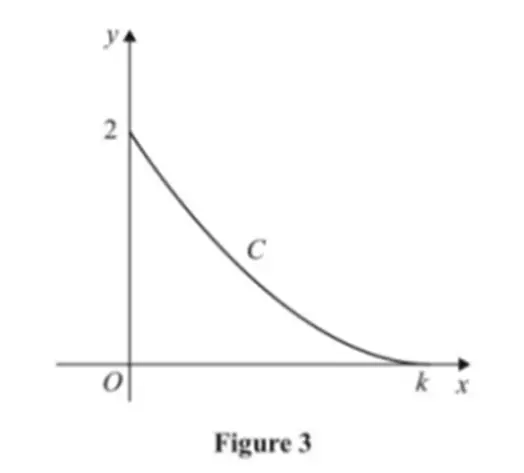
Figure 3 shows a sketch of the curve \( C \) with parametric equations
\[x = 6t – 3 \sin 2t \quad y = 2 \cos t \quad 0 \leq t \leq \frac{\pi}{2}\]
The curve meets the \( y \)-axis at 2 and the \( x \)-axis at k, where k is a constant.
(a) State the value of k.
(1)
(1)
(b) Use parametric differentiation to show that
\[\frac{dy}{dx} = \lambda \csc t\]
where \(\lambda\) is a constant to be found.
(4)
The point P with parameter \[t = \frac{\pi}{4}\] lies on C.
(c) Find the exact y coordinate of N, giving your answer in simplest form.
(3)
(3)
The region bounded by the curve, the x-axis and the y-axis is rotated through \(2\pi\) radians about the x-axis to form a solid of revolution.
(d)
(i) Show that the volume of this solid is given by
\[\int_{0}^{a} \beta (1 – \cos 4t) dt\]
where a and \(\beta\) are constants to be found.
(ii) Hence, using algebraic integration, find the exact volume of this solid.
(6)
(6)
Solution to Part a: Find x-intercept k.
Key Concepts Used:
- Parametric Curve Analysis:
Understanding how parametric equations define x and y coordinates separately. - Axis Intersection Logic:
Curve meets x-axis when \( y = 0 \). - Trigonometric Evaluation:
Exact values of trigonometric functions at standard angles.
Step-by-Step Solution:
1. Set \( y = 0 \) for x-axis intersection:
\[2\cos t = 0 \Rightarrow \cos t = 0 \Rightarrow t = \frac{\pi}{2}\]
2. Find corresponding x-coordinate:
\[x = 6 \left( \frac{\pi}{2} \right) – 3\sin\pi = 3\pi – 0 = 3\pi\]
Final Answer:
\[3\pi\]
Solution to Part b: Show \(\frac{dy}{dx} = \lambda \csc t\)
Key Concepts Used:
- Parametric Differentiation:
Using chain rule \(\frac{dy}{dx} = \frac{dy/dt}{dx/dt}\) - Trigonometric Identities:
\(1 – \cos 2t = 2\sin^2 t\). - Simplification Techniques:
Reducing complex fractions to simplest form.
Step-by-Step Solution:
\[\frac{dx}{dt} = 6 – 6\cos 2t = 6(1 – \cos 2t)\]
\[\frac{dy}{dt} = -2\sin t\]
2. Find \(\frac{dy}{dx}\):
\[\frac{dy}{dx} = \frac{-2\sin t}{6(1 – \cos 2t)} = \frac{- \sin t}{3(2\sin^2 t)} = -\frac{1}{6\sin t} = -\frac{1}{6}\csc t\]
Final Answer:
\[\lambda = -\frac{1}{6}\]
Solution to Part c: Find y-coordinate of point N
Key Concepts Used:
- Tangent Line Equation:
Using point-slope form \(y – y_1 = m(x – x_1)\). - Exact Trigonometric Values:
\[ \cos \frac{\pi}{4} = \frac{\sqrt{2}}{2}, \quad \csc \frac{\pi}{4} = \sqrt{2}.\] - Y-intercept Calculation:
Setting \(x = 0\) in linear equation.
Step-by-Step Solution:
1. Find point \( P \) at \( t = \frac{\pi}{4} \):
\[x = 6t – 3 \sin 2t = 6 \left( \frac{\pi}{4} \right) – 3 \sin \left( \frac{\pi}{2} \right) = \frac{3\pi}{2} – 3\]
\[y = 2 \cos t = 2 \cos \left( \frac{\pi}{4} \right) = \sqrt{2}\]
\[P = \left( \frac{3\pi}{2} – 3, \sqrt{2} \right)\]
2. Determine tangent slope:
We already know that \(\frac{dy}{dx} = -\frac{1}{6} \csc t\). And dy/dx is the gradient of tangent.
\[m = -\frac{1}{6} \csc \left( \frac{\pi}{4} \right) = -\frac{\sqrt{2}}{6}\]
3. Write tangent equation:
The equation of tangent can be found using point-slope formula.
\[y – y_1 = m(x – x_1)\]
\[y – \sqrt{2} = -\frac{\sqrt{2}}{6} \left( x – \left( \frac{3\pi}{2} – 3 \right) \right)\]
4. Find y-intercept (\( x = 0 \)):
\[y = \sqrt{2} + \frac{\sqrt{2}}{6} \left( \frac{3\pi}{2} – 3 \right) = \sqrt{2} \left( 1 + \frac{\pi}{4} – \frac{1}{2} \right)\]
Final Answer:
\[\sqrt{2} \left( \frac{\pi}{4} + \frac{1}{2} \right)\]
Solution to Part d(i): Volume Integral Form
Key Concepts Used:
- Volume of Revolution:
\[V = \pi \int y^2 dx.\] - Parametric Integration:
Converting \( dx \) to \(\frac{dx}{dt} dt\). - Trigonometric Identities:
\[\cos 2t = 2 \cos^2 t – 1\]\[\cos^2 t = \frac{1 + \cos 2t}{2}\]\[\cos^2 2t = \frac{1 + \cos 4t}{2}\]
Step-by-Step Solution:
1. Set up integral, applying the Volume of Revolution formula:
\[V = \pi \int y^2 dx\]
\[V = \pi \int (2 \cos t)^2 \cdot 6(1 – \cos 2t) dt = 24\pi \int \cos^2 t (1 – \cos 2t) dt\]
2. Simplify using identities:
\[V = 12\pi \int (1 + \cos 2t)(1 – \cos 2t) dt = 12\pi \int (1 – \cos^2 2t) dt\]
\[= 6\pi \int (1 – \cos 4t) dt\]
Final Answer:
\[\int_0^{\pi/2} 6\pi (1 – \cos 4t) dt\]
Solution to Part d(ii): Exact Volume Calculation
Key Concepts Used:
- Definite Integration: Evaluating integrals with exact trigonometric values.
- Fundamental Theorem of Calculus:
\[\int (1 – \cos 4t) dt = t – \frac{1}{4} \sin 4t\]
- Exact Value Substitution:
\[\sin 2\pi = 0, \sin 0 = 0\]
Step-by-Step Solution:
1. Integrate:
\[6\pi \left[ t – \frac{\sin 4t}{4} \right]_0^{\pi/2} = 6\pi \left( \frac{\pi}{2} – 0 \right)\]
2. Calculate:
\[= 3\pi^2\]
Final Answer:
\[3\pi^2\]