Edexcel IAL June 2023 P4 (WMA14/01) Q8 Parametric Equation, Differentiation, Volume of Revolutions
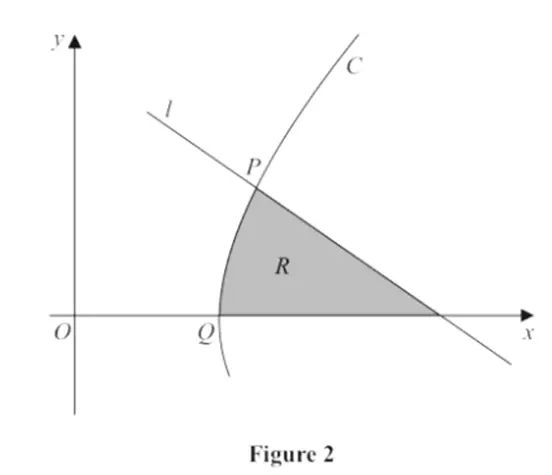
Figure 2 shows a sketch of part of the curve C with parametric equations
\[x = t + \frac{1}{t} \quad y = t – \frac{1}{t} \quad t > 0.7\]
The curve C intersects the x-axis at the point Q.
(a) Find the x coordinate of Q. (1)
The line / is the normal to C at the point P as shown in Figure 2.
Given that =2 at P
(b) Write down the coordinates of P. (1)
(c) Using Calculus, show that the equation of \( l \) is
\[3x + 5y = 15\]
(3)
The region, R, shown shaded in Figure 2 is bounded by the curve C, the line I and the x-axis.
(d) Using algebraic integration, find the exact volume of the solid of revolution formed when the region R is rotated through 27 radians about the x-axis. (7)
Solution to Part a: Find the x-coordinate of Q.
Key Concepts Used:
- Parametric Equations: The curve is defined in terms of parameter \( t \).
- x-axis Intersection: On the x-axis, \( y = 0 \).
Step-by-Step Solution:
1. Set \( y = 0 \) for x-axis intersection:
\[y = t – \frac{1}{t} = 0\]
Solve for \( t \):
\[t – \frac{1}{t} = 0 \Rightarrow t^2 – 1 = 0 \Rightarrow t^2 = 1 \Rightarrow t = 1 \quad (\text{since } t > 0)\]
2. Find x-coordinate using \( t = 1 \):
\[x = t + \frac{1}{t} = 1 + \frac{1}{1} = 2\]
Final Answer:
The curve intersects the x-axis at x=2.
\[x = 2\]
Solution to Part b: Coordinates of P.
Key Concepts Used:
- Given Parameter Value: At point \( P \), \( t = 2 \).
- Parametric Equations: Substitute \( t = 2 \) into \( x \) and \( y \).
Step-by-Step Solution:
1. Substitute \( t = 2 \) into \( x \):
\[x = 2 + \frac{1}{2} = \frac{5}{2}\]
2. Substitute \( t = 2 \) into \( y \):
3. Hence, the coordinates of \( P \) are \(\left( \frac{5}{2}, \frac{3}{2} \right) \).
Final Answer:
The coordinates of P are
\[\left( \frac{5}{2}, \frac{3}{2} \right)\]
Solution to Part c: Equation of Normal Line l.
Key Concepts Used:
- Find derivative \(\frac{dy}{dx}\) using parametric differentiation.
- Slope of tangent at \( P \), then slope of normal.
- Use point-slope form to find equation.
Step-by-Step Solution:
1. Compute \(\frac{dx}{dt}\) and \(\frac{dy}{dt}\):
\[\frac{dx}{dt} = 1 – \frac{1}{t^2}, \quad \frac{dy}{dt} = 1 + \frac{1}{t^2}\]
2. Find \(\frac{dy}{dx}\):
\[\frac{dy}{dx} = \frac{dy/dt}{dx/dt} = \frac{1 + \frac{1}{t^2}}{1 – \frac{1}{t^2}} = \frac{t^2 + 1}{t^2 – 1}\]
3. At \( t = 2 \):
\[\frac{dy}{dx} = \frac{4 + 1}{4 – 1} = \frac{5}{3}\]
So, slope of tangent at \( P \) is \(\frac{5}{3}\).
4. Slope of normal is negative reciprocal:
\[m_{\text{normal}} = -\frac{3}{5}\]
(Why is the normal slope negative reciprocal?
5. Equation of normal through \( P \left( \frac{5}{2}, \frac{3}{2} \right) \):
\[y – \frac{3}{2} = -\frac{3}{5} \left( x – \frac{5}{2} \right)\]
6. Multiply both sides by 10 to eliminate denominators:
\[10(y – \frac{3}{2}) = 10 \cdot \left( -\frac{3}{5} \right) \left( x – \frac{5}{2} \right)\]
\[10y – 15 = -6 \left( x – \frac{5}{2} \right)\]
\[10y – 15 = -6x + 15\]
\[6x + 10y = 30\]
Divide by 2:
\[3x + 5y = 15\]
Hence, the equation of l is \( 3x + 5y = 15 \).
Final Answer:
\[3x + 5y = 15\]
Solution to Part d: Volume of Solid of Revolution
Key Concepts Used:
- Volume when rotated about x-axis: \( V = \pi \int y^2 dx \).
- For parametric curve: \( V = \pi \int_{t_1}^{t_2} y^2 \frac{dx}{dt} dt \).
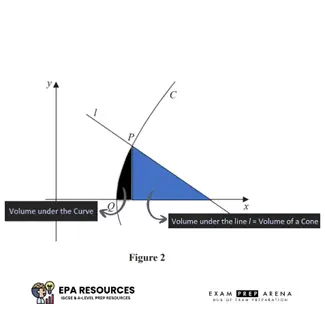
- Region R is bounded by:
- Curve C from Q (\( t = 1 \)) to P (\( t = 2 \))
- Line l from P to x-axis (at \( x = 5 \))
- x-axis from \( x = 2 \) to \( x = 5 \)
- Total volume = volume under curve + volume under line (cone).
Step-by-Step Solution:
1. Volume Under Curve (Parametric Part):
\[V_{\text{curve}} = \pi \int_{t=1}^{t=2} y^2 \frac{dx}{dt} dt\]
Compute \( y^2 \) and \(\frac{dx}{dt}\):
\[y = t – \frac{1}{t} \Rightarrow y^2 = \left( t – \frac{1}{t} \right)^2 = t^2 – 2 + \frac{1}{t^2}\]
\[\frac{dx}{dt} = 1 – \frac{1}{t^2}\]
So,
\[y^2 \frac{dx}{dt} = \left( t^2 – 2 + \frac{1}{t^2} \right) \left( 1 – \frac{1}{t^2} \right)\]
Expand:
\[y^2 \frac{dx}{dt} = t^2 \cdot 1 – t^2 \cdot \frac{1}{t^2} – 2 \cdot 1 + 2 \cdot \frac{1}{t^2} + \frac{1}{t^2} \cdot 1 – \frac{1}{t^2} \cdot \frac{1}{t^2}\]
\[= t^2 – 1 – 2 + \frac{2}{t^2} + \frac{1}{t^2} – \frac{1}{t^4}\]
\[= t^2 – 3 + \frac{3}{t^2} – \frac{1}{t^4}\]
Therefore,
\[V_{\text{curve}} = \pi \int_1^2 \left( t^2 – 3 + 3t^{-2} – t^{-4} \right) dt\]
2. Integrate term by term:
\[\int \left( t^2 – 3 + 3t^{-2} – t^{-4} \right) dt = \frac{t^3}{3} – 3t – 3t^{-1} + \frac{1}{3}t^{-3}\]
Evaluate from 1 to 2:
• At \( t = 2 \):
\[\frac{8}{3} – 6 – \frac{3}{2} + \frac{1}{24} = \frac{64}{24} – \frac{144}{24} – \frac{36}{24} + \frac{1}{24} = -\frac{115}{24}\]
• At \( t = 1 \):
\[\frac{1}{3} – 3 – 3 + \frac{1}{3} = \frac{2}{3} – 6 = \frac{2}{3} – \frac{18}{3} = \frac{-16}{3} = \frac{-128}{24}\]
Difference:
\[\frac{-115}{24} – \left( \frac{-128}{24} \right) = \frac{13}{24}\]
So,
\[V_{\text{curve}} = \pi \cdot \frac{13}{24} = \frac{13}{24} \pi\]
4. Volume Under Line l (Cone):
(Why is the volume under the line l a cone?
The line is straight, so rotating it forms a conical solid.)
Line l:
\[3x + 5y = 15 \implies y = \frac{15 – 3x}{5}\]
x-intercept: set \( y = 0 \implies x = 5 \)
At \( P, x = \frac{5}{2} \)
Rotating the triangle under l from \( x = \frac{5}{2} \) to \( x = 5 \) forms a cone.
Radius at base:
\[y \, \text{at } x = \frac{5}{2} \text{ is } \frac{3}{2}\]
Height:
\[5 – \frac{5}{2} = \frac{5}{2}\]
Volume of cone:
\[V_{\text{cone}} = \frac{1}{3} \pi r^2 h = \frac{1}{3} \pi \left( \frac{3}{2} \right)^2 \cdot \frac{5}{2} = \frac{1}{3} \pi \cdot \frac{9}{4} \cdot \frac{5}{2} = \frac{45}{24} \pi = \frac{15}{8} \pi\]
5. Total Volume:
\[V_{\text{total}} = V_{\text{curve}} + V_{\text{cone}} = \frac{13}{24} \pi + \frac{15}{8} \pi\]
6. Simplify the total volume:
Convert \(\frac{15}{8} = \frac{45}{24}\):
\[V_{\text{total}} = \frac{13 + 45}{24} \pi = \frac{58}{24} \pi = \frac{29}{12} \pi\]
Final Answer:
\[\frac{29}{12} \pi\]