
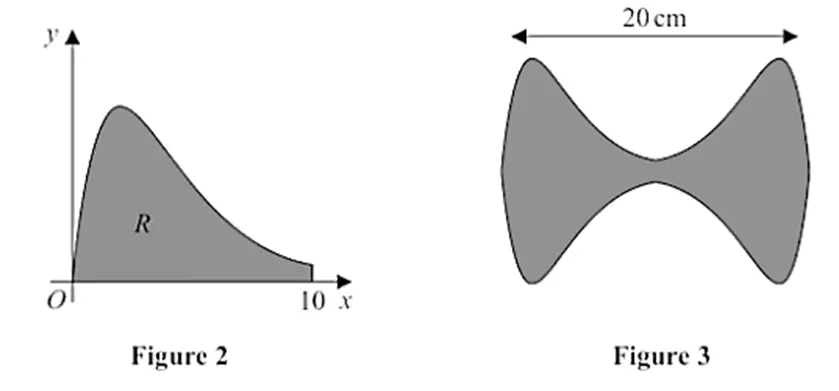
Figure 2 shows the curve with equation
The finite region \( R \), shown shaded in Figure 2, is bounded by the curve, the x-axis and the line with equation \( x = 10 \)
The region \( R \) is rotated through \( 2\pi \) radians about the x-axis to form a solid of revolution.
where \( k \) is a constant to be found.(2)
Figure 3 represents an exercise weight formed by joining two of these solids together.
The exercise weight has mass 5kg and is 20 cm long.
Given that
And using your answers to part (a) and part (b)
(c) find the density of this exercise weight. Give your answer in grams per cm\(^3\) to 3 significant figures.
- Volume of Revolution: \( V = \pi \int_{a}^{b} y^2 dx \) for rotation about the x-axis.
- Algebraic Manipulation: Express \( y^2 \) and simplify.
-
Given curve:
\( y = 10xe^{-\frac{1}{2}x} \)
-
Compute \( y^2 \):
\( y^2 = (10xe^{-\frac{1}{2}x})^2 = 100x^2e^{-x} \)
since \( (e^{-\frac{1}{2}x})^2 = e^{-x} \). -
Volume integral:
\( V = \pi \int_{0}^{10} y^2 dx = \pi \int_{0}^{10} 100x^2e^{-x} dx = 100\pi \int_{0}^{10} x^2e^{-x} dx \)
-
Compare with given form:
\( V = k \int_{0}^{10} x^2e^{-x} dx \)
So, \( k = 100\pi \).
- Integration by Parts: \( \int u dv = uv – \int v du \)
- Apply twice to reduce the power of \( x \)
-
Let
\( I = \int x^2 e^{-x} dx \)
(How to integrate \( x^2 e^{-x} \) ? Use integration by parts twice, reducing the power of \( x \) each time.)
-
First integration by parts: Let
\( u = x^2, \quad dv = e^{-x} dx \)
Then
\( du = 2x dx, \quad v = -e^{-x} \)
So,
\( I = -x^2 e^{-x} – \int (-e^{-x}) \cdot 2x dx = -x^2 e^{-x} + 2 \int xe^{-x} dx \) -
Second integration by parts for \( \int xe^{-x} dx \): Let
\( u = x, \quad dv = e^{-x} dx \)
Then
\( du = dx, \quad v = -e^{-x} \)
So,
\( \int xe^{-x} dx = -xe^{-x} – \int (-e^{-x}) dx = -xe^{-x} + \int e^{-x} dx = -xe^{-x} – e^{-x} \) -
Substitute back:
\( I = -x^2 e^{-x} + 2(-xe^{-x} – e^{-x}) = -x^2 e^{-x} – 2xe^{-x} – 2e^{-x} + C \)
- Volume of one solid from part (a)
- Volume of two solids (exercise weight)
- Density formula: density = \(\frac{\text{mass}}{\text{volume}}\)
-
Volume of one solid:
From (a),
\( V_1 = 100\pi \int_{0}^{10} x^2 e^{-x} dx \)
Using the antiderivative from (b):
\( \int_{0}^{10} x^2 e^{-x} dx = [-x^2 e^{-x} – 2xe^{-x} – 2e^{-x}]_{0}^{10} \) -
Evaluate at limits:
○ At \( x = 10 \):
\( -100e^{-10} – 20e^{-10} – 2e^{-10} = -122e^{-10} \)
○ At \( x = 0 \):
\( 0 – 0 – 2e^{0} = -2 \)
So,
\( \int_{0}^{10} x^2 e^{-x} dx = (-122e^{-10}) – (-2) = 2 – 122e^{-10} \) -
Volume of one solid:
\( V_1 = 100\pi(2 – 122e^{-10}) \)
-
Volume of two solids (exercise weight):
\( V_{\text{total}} = 2 \times V_1 = 200\pi(2 – 122e^{-10}) \)
-
Mass: 5 kg = 5000 grams.
(Why convert mass to grams?
Density is asked in g/cm\(^3\), so mass must be in grams and volume in cm\(^3\).) -
Density:
\( \text{density} = \frac{5000}{200\pi(2 – 122e^{-10})} = \frac{25}{\pi(2 – 122e^{-10})} \)
-
Numerical evaluation:
– \( e^{-10} \approx 4.53999 \times 10^{-5} \)
– \( 122e^{-10} \approx 122 \times 4.53999 \times 10^{-5} \approx 0.005539 \)
– \( 2 – 0.005539 = 1.994461 \)
– \( \pi \times 1.994461 \approx 6.265 \)
– \( \frac{25}{6.265} \approx 3.99 \)
So, density = 3.99 g/cm\(^3\)