Edexcel IAL October 2022 P4 (WMA14/01) Q5 Parametric Equation, Differentiation, Volume of Revolutions
In this question you must show all stages of your working. Solutions relying entirely on calculator technology are not acceptable.
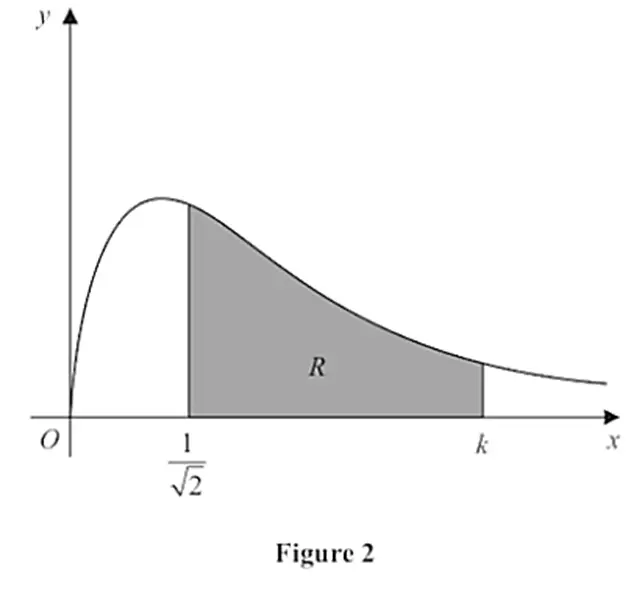
Figure 2 shows a sketch of part of the curve with equation
\[y = \frac{12\sqrt{x}}{(2x^2 + 3)^{1.5}}\]
The region \( R \), shown shaded in Figure 2, is bounded by the curve, the line with equation \( x = \frac{1}{\sqrt{2}} \) the x-axis and the line with equation \( x=k \).
This region is rotated through \( 360^\circ \) about the x-axis to form a solid of revolution.
Given that the volume of this solid is \( \frac{713}{648} \pi \), use algebraic integration to find the exact value of the constant \( k \).
Solution: Volume of Solid of Revolution
Key Concepts Used:
- Volume of Revolution: The volume \( V \) when a curve \( y = f(x) \) is rotated about the x-axis from \( x = a \) to \( x = b \) is given by
\[V = \pi \int_{a}^{b} y^2 dx\]
- Substitution Method: To simplify the integral, use a substitution that matches the denominator.
- Algebraic Manipulation: Solve for \( k \) using the given volume.
Step-by-Step Solution:
1. Express \( y^2 \)
Given:
\[y = \frac{12\sqrt{x}}{(2x^2 + 3)^{1.5}}\]
Then:
\[y^2 = \left( \frac{12\sqrt{x}}{(2x^2 + 3)^{1.5}} \right)^2 = \frac{144x}{(2x^2 + 3)^3}\]
2. Set Up the Volume Integral
The volume is:
\[V = \pi \int_{1/\sqrt{2}}^{k} y^2 dx = \pi \int_{1/\sqrt{2}}^{k} \frac{144x}{(2x^2 + 3)^3} dx\]
Given that \( V = \frac{713}{648} \pi \), so:
\[\pi \int_{1/\sqrt{2}}^{k} \frac{144x}{(2x^2 + 3)^3} dx = \frac{713}{648} \pi\]
Divide both sides by \( \pi \):
\[\int_{1/\sqrt{2}}^{k} \frac{144x}{(2x^2 + 3)^3} dx = \frac{713}{648}\]
3. Use Substitution
Let:
\[u = 2x^2 + 3\]
(Why choose \( u = 2x^2 + 3 \)?
The denominator is \((2x^2 + 3)^3\), and its derivative is \(4x\), which cancels with the \(x\) in the numerator. This substitution simplifies the integral.)
Then:
\[\frac{du}{dx} = 4x \quad \Rightarrow \quad dx = \frac{du}{4x}\]
Change limits:
– When \( x = \frac{1}{\sqrt{2}} \):
\[u = 2\left(\frac{1}{\sqrt{2}}\right)^2 + 3 = 2 \cdot \frac{1}{2} + 3 = 1 + 3 = 4\]
– When \( x = k \):
\[u = 2k^2 + 3\]
4. Rewrite the Integral in Terms of \(u\)
Substitute:
\[\int \frac{144x}{u^3} \cdot \frac{du}{4x} = \int \frac{144}{4} \cdot \frac{1}{u^3} du = 36 \int u^{-3} du\]
So:
\[\int_{x=1/\sqrt{2}}^{x=k} \frac{144x}{(2x^2 + 3)^3} dx = 36 \int_{u=4}^{u=2k^2+3} u^{-3} du\]
5. Integrate with Respect to \(u\)
\[\int u^{-3} du = \frac{u^{-2}}{-2} = -\frac{1}{2u^2}\]
So:
\[36 \left[ -\frac{1}{2u^2} \right]_4^{2k^2+3} = -18 \left[ \frac{1}{u^2} \right]_4^{2k^2+3} = -18 \left( \frac{1}{(2k^2 + 3)^2} – \frac{1}{16} \right)\]
Thus:
\[\int_{1/\sqrt{2}}^{k} \frac{144x}{(2x^2 + 3)^3} dx = -18 \left( \frac{1}{(2k^2 + 3)^2} – \frac{1}{16} \right) = \frac{713}{648}\]
6. Solve for k
Multiply both sides by -1:
\[18 \left( \frac{1}{(2k^2 + 3)^2} – \frac{1}{16} \right) = -\frac{713}{648}\]
Divide both sides by 18:
\[\frac{1}{(2k^2 + 3)^2} – \frac{1}{16} = -\frac{713}{648 \cdot 18}\]
Calculate \[648 \cdot 18\]:
\[648 \cdot 18 = 648 \cdot (20 – 2) = 12960 – 1296 = 11664\]
So:
\[\frac{1}{(2k^2 + 3)^2} – \frac{1}{16} = -\frac{713}{11664}\]
Add \(\frac{1}{16}\) to both sides:
\[\frac{1}{(2k^2 + 3)^2} = \frac{1}{16} – \frac{713}{11664}\]
Convert \(\frac{1}{16}\) to denominator 11664:
\[\frac{1}{16} = \frac{729}{11664} \quad (\text{since } 11664 \div 16 = 729)\]
So:
\[\frac{1}{(2k^2 + 3)^2} = \frac{729 – 713}{11664} = \frac{16}{11664} = \frac{1}{729}\]
Thus:
\[(2k^2 + 3)^2 = 729\]
Take square root:
\[2k^2 + 3 = 27 \quad (\text{since } 2k^2 + 3 > 0)\]
Solve for \(k^2\):
\[2k^2 = 24 \Rightarrow k^2 = 12\]
So:
\[k = \sqrt{12} = 2\sqrt{3} \quad (\text{since } k > 0)\]
Final Answer:
\[2\sqrt{3}\]