
Edexcel IAL October 2020 P4 (WMA14/01) Q2 Parametric Equation, Differentiation, Volume of Revolutions
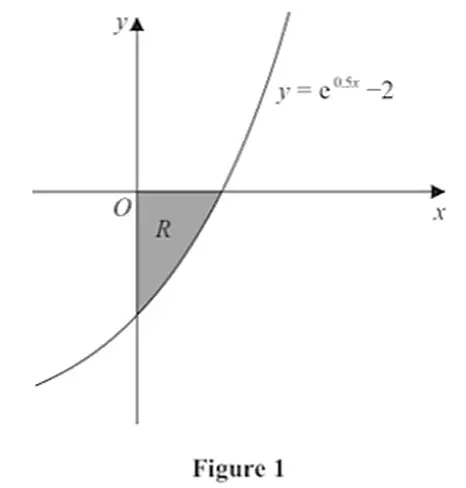
Figure 1 shows a sketch of part of the curve with equation \( y = e^{0.5x} – 2 \)
The region \( R \), shown shaded in Figure 1, is bounded by the curve, the x-axis and the y-axis.
The region \( R \) is rotated \( 360^\circ \) about the x-axis to form a solid of revolution.
Show that the volume of this solid can be written in the form \( \frac{1}{2} \ln 2 + b \), where a and b are constants to be found.
Solution to Question: Volume of Revolution
Key Concepts Used:
- Volume of Revolution: \( V = \pi \int_a^b y^2 dx \) for rotation about the x-axis
- Integration of Exponential Functions: \( \int e^{kx} dx = \frac{1}{k} e^{kx} + C \)
- Finding Limits: The region is bounded by the curve, x-axis, and y-axis
Step-by-Step Solution:
-
Find the Limits of Integration
– The region is bounded by the curve \( y = e^{0.5x} – 2 \), the x-axis (\( y = 0 \)), and the y-axis (\( x = 0 \)).
– To find the x-intercept, set \( y = 0 \):
– \( e^{0.5x} – 2 = 0 \Rightarrow e^{0.5x} = 2 \Rightarrow 0.5x = \ln 2 \Rightarrow x = 2\ln 2 \)
– So, the region extends from \( x = 0 \) to \( x = 2\ln 2 \). -
Express \( y^2 \)
\( y = e^{0.5x} – 2 \Rightarrow y^2 = (e^{0.5x} – 2)^2 = e^x – 4e^{0.5x} + 4 \)
-
Set Up the Volume Integral
\( V = \pi \int_0^{2\ln 2} y^2 dx = \pi \int_0^{2\ln 2} (e^x – 4e^{0.5x} + 4) dx \)
-
Integrate Term by Term
\( \int (e^x – 4e^{0.5x} + 4) dx = e^x – 4 \cdot \frac{e^{0.5x}}{0.5} + 4x + C = e^x – 8e^{0.5x} + 4x + C \)
-
Evaluate the Definite Integral
Evaluate from \( x = 0 \) to \( x = 2\ln 2 \):
At \( x = 2\ln 2 \):
\( e^{2\ln 2} = e^{\ln 4} = 4 \)
\( e^{0.5 \cdot 2\ln 2} = e^{\ln 2} = 2 \)
\( 4x = 4 \cdot 2\ln 2 = 8\ln 2 \)
So,
\( [e^x – 8e^{0.5x} + 4x]_{0}^{2\ln 2} = (4 – 8 \cdot 2 + 8\ln 2) – (1 – 8 \cdot 1 + 0) = (4 – 16 + 8\ln 2) – (1 – 8) = (-12 + 8\ln 2) – (-7) \)
\( = -12 + 8\ln 2 + 7 = 8\ln 2 – 5 \) -
Multiply by \( \pi \)
\( V = \pi (8\ln 2 – 5) = 8\pi \ln 2 – 5\pi \)
This is in the form \( a\ln 2 + b \) with \( a = 8\pi \) and \( b = -5\pi \).
Final Answer:
\( 8\pi \ln 2 – 5\pi \)
So, \( a = 8\pi, b = -5\pi \)
So, \( a = 8\pi, b = -5\pi \)