
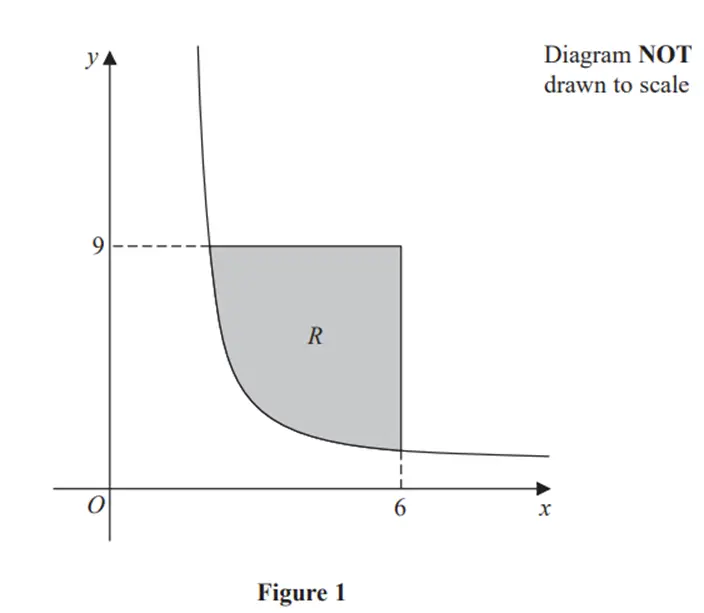
Figure 1 shows a sketch of part of the curve with equation
Figure 1 shows a sketch of part of the curve with equation
The finite region \( R \), shown shaded in Figure 1, is bounded by the curve, the line with equation \( y = 9 \) and the line with equation \( x = 6 \). This region is rotated through \( 2\pi \) radians about the \( x \)-axis to form a solid of revolution.
Find, by algebraic integration, the exact volume of the solid generated.
- Volume of Revolution: \( V = \pi \int_{a}^{b} y^2 dx \) for rotation about the \( x \)-axis
- Subtraction of Volumes: The region \( R \) is under \( y = 9 \) but above the curve, so volume = volume of cylinder – volume under curve
- Substitution: Let \( u = 2x – 3 \) to simplify the integral
-
Understand the Region R
The region is bounded by:
Curve:
\( y = \frac{9}{(2x – 3)^{1.25}} \)
Horizontal line:
\( y = 9 \)
Vertical line:
\( x = 6 \)
Find the left boundary (where curve and line meet):
Set \( y = 9 \):
\( 9 = \frac{9}{(2x – 3)^{1.25}} \Rightarrow (2x – 3)^{1.25} = 1 \Rightarrow 2x – 3 = 1 \Rightarrow x = 2 \)
So, region R is from \( x = 2 \) to \( x = 6 \). -
Volume of the Cylinder
The region under \( y = 9 \) from \( x = 2 \) to \( x = 6 \) forms a cylinder when rotated.
Volume of cylinder:
\( V_{cylinder} = \pi \int_{2}^{6} (9)^2 dx = \pi \int_{2}^{6} 81 dx = 81\pi[x]_{2}^{6} = 81\pi(6 – 2) = 324\pi \) -
Volume Under the Curve
The volume generated by the curve when rotated is:
\( V_{curve} = \pi \int_{2}^{6} \left( \frac{9}{(2x – 3)^{1.25}} \right)^2 dx = \pi \int_{2}^{6} \frac{81}{(2x – 3)^{2.5}} dx \) -
Use Substitution
Let \( u = 2x – 3 \), then \( du = 2dx \Rightarrow dx = \frac{du}{2} \).(Why choose \( u = 2x – 3 \)?
The denominator is \( (2x – 3)^{2.5} \), and its derivative is 2, which helps cancel out.)Now, change limits:
* When \( x = 2, u = 2(2) – 3 = 1 \)
* When \( x = 6, u = 2(6) – 3 = 9 \)
So,
\( V_{\text{curve}} = \pi \int_{u=1}^{u=9} \frac{81}{u^{2.5}} \cdot \frac{du}{2} = \frac{81\pi}{2} \int_{1}^{9} u^{-2.5} du \) -
Integrate
\( \int u^{-2.5} du = \int u^{-5/2} du = \frac{u^{-3/2}}{-3/2} = -\frac{2}{3} u^{-3/2} \)
So,
\( V_{\text{curve}} = \frac{81\pi}{2} \left[ -\frac{2}{3} u^{-3/2} \right]_{1}^{9} = \frac{81\pi}{2} \left( -\frac{2}{3} \right) \left[ u^{-3/2} \right]_{1}^{9} = -27\pi \left[ u^{-3/2} \right]_{1}^{9} \) -
Evaluate:
– At \( u = 9; 9^{-3/2} = (9^{1/2})^{-3} = 3^{-3} = \frac{1}{27} \)
– At \( u = 1; 1^{-3/2} = 1 \)
So,
\( V_{\text{curve}} = -27\pi \left( \frac{1}{27} – 1 \right) = -27\pi \left( \frac{1 – 27}{27} \right) = -27\pi \cdot \left( -\frac{26}{27} \right) = 26\pi \) -
Net Volume
The actual volume of the solid is the volume of the cylinder minus the volume under the curve:
\( V = V_{\text{cylinder}} – V_{\text{curve}} = 324\pi – 26\pi = 298\pi \)(Why subtract volumes?
The region R is above the curve but below \( y = 9 \), so rotating it gives a solid with a hole (like a bowl). The volume is the cylinder minus the volume under the curve.)