

Edexcel IAL January 2023 P4 (WMA14/01) Q1 Partial Fraction, Binomial Expansion
\[f(x) = \frac{5x + 10}{(1 – x)(2 + 3x)}\]
(a) Write f(x) in partial fraction form.(3)
(b)
(i) Hence find, in ascending powers of x up to and including the terms in \(x^2\), the binomial series expansion of f(x). Give each coefficient as a simplified fraction.(5)
(ii) Find the range of values of x for which this expansion is valid.
(1)
Solution to Part a: Expression of f(x) in partial fractions.
Key Concepts Used
- Partial Fractions: Distinct linear factors
Step-by-Step Solution
- Set \(\frac{5x + 10}{(1 – x)(2 + 3x)}\) identical to \(\frac{A}{1 – x} + \frac{B}{2 + 3x}\)
\[\frac{5x + 10}{(1 – x)(2 + 3x)} = \frac{A}{1 – x} + \frac{B}{2 + 3x}\]
- Let’s find the value of A & B.
Add the two fractions.
\[\frac{5x + 10}{(1 – x)(2 + 3x)} = \frac{A(2 + 3x) + B(1 – x)}{(1 – x)(2 + 3x)}\]
\[\frac{5x + 10}{(1 – x)(2 + 3x)} = A(2 + 3x) + B(1 – x)\]To find A, substitute \(x = 1\).
\[5(1) + 10 = A(2 + 3 \times 1) + B(1 – 1)\]
\[15 = 5A\]
\[A = 3\]To find B, substitute \( x = -\frac{2}{3} \)
\[ 5\left(-\frac{2}{3}\right) + 10 = A \left(2 + 3 \times -\frac{2}{3}\right) + B \left(1 – \left(-\frac{2}{3}\right)\right) \]
\[\frac{20}{3} = \frac{5}{3}B\]
\[B = 4\] - Hence,
\[\frac{5x + 10}{(1 – x)(2 + 3x)} = \frac{3}{1 – x} + \frac{4}{2 + 3x}\]
Final Answer
\[\frac{5x + 10}{(1 – x)(2 + 3x)} = \frac{3}{1 – x} + \frac{4}{2 + 3x}\]
Solution to Part b: Binomial Expansion
Key Concepts Used
- Binomial Expansion
\[(1 + y)^n \approx 1 + ny + \frac{n(n-1)}{2}y^2 + \cdots \text{ for } |y| < 1.\]
Step-by-Step Solution
- First, write in the index form.
\[f(x) = \frac{3}{1 – x} + \frac{4}{2 + 3x}\]
\[f(x) = 3(1 – x)^{-1} + 4(2 + 3x)^{-1}\]
\[(1 – x)^n = 1 + nx \frac{n(n-1)}{2!}x^2 + \frac{n(n-1)(n-2)}{3!}x^3 + \cdots + \frac{n(n-1) \cdots (n-r+1)}{r!}x^r\] - Let us find out the expansion of \((1 – x)^{-1}\) first separately using binomial expansion.
Replace n by -1. And since n is not positive, so no term of the expansion would ever be positive.
\[(1 – x)^{-1} = 1 + (-1)(-x) + \frac{-1(-2)(-x)^2}{2} + \cdots\]
\[(1 – x)^{-1} = 1 + x + x^2 + \cdots\]
Now, find out the expansion of \((2 + 3x)^{-1}\) separately using binomial expansion.\[(2+3x)^{-1} = \left[ 2\left( 1 + \frac{3}{2}x \right) \right]^{-1}\] - Take out a factor of \(2^{-1}\).
\[(2+3x)^{-1} = 2^{-1}\left( 1 + \frac{3}{2}x \right)^{-1}\]
\[= \frac{1}{2}\left( 1 + \frac{3}{2}x \right)^{-1}\]
Now, finding the expansion.
\[\frac{1}{2}\left( 1 + \frac{3}{2}x \right)^{-1} = \frac{1}{2}\left[ 1 – \frac{3}{2}x + \frac{-1(-2)}{2}\left( \frac{3}{2}x \right)^2 + \cdots \right]\]
Hence, combining the expansions.\[3(1-x)^{-1} + 4(2+3x)^{-1} = 3(1+x+x^2+\cdots) + \frac{4 \cdot 1}{2}\left( 1 – \frac{3}{2}x + \frac{9}{4}x^2 \right)\]
\[= 3+3x+3x^2+2-3x+\frac{9}{2}x^2\]
\[= 5 + \frac{15}{2}x^2\]
Final Answer
\[f(x) = 5 + \frac{15}{2}x^2\]
Solution to Part c: Validity of Expansion
Key Concepts Used
- Convergence Condition: \(|y| < 1\) for \((1 + y)^n\).
- Apply to Each Term:
- \((1 – x)^{-1}\): Valid for \(|x| < 1\)
- \((1 + \frac{3}{2}x)^{-1}\): Valid for \(\left|\frac{3}{2}x\right| < 1 \Rightarrow |x| < \frac{2}{3}\)
Step-by-Step Solution
\[3(1 – x)^{-1} + 2\left(1 + \frac{3}{2}x\right)^{-1} = 5 + \frac{15}{2}x^2\]
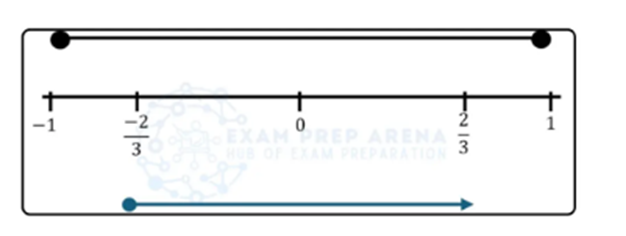
The expansion of \((1 – x)^{-1}\) is valid as long as \(|x| < 1\) or in other words \(-1 < x < 1\).
Whereas for \(\left(1 + \frac{3}{2}x\right)^{-1}\) is valid as long as \(\left|\frac{3x}{2}\right| < 1\) or in other words \(-\frac{2}{3} < x < \frac{2}{3}\)
The expansion of \((1 – x)^{-1}\) is valid as long as \(|x| < 1\) or in other words \(-1 < x < 1\).
Whereas for \(\left(1 + \frac{3}{2}x\right)^{-1}\) is valid as long as \(\left|\frac{3x}{2}\right| < 1\) or in other words \(-\frac{2}{3} < x < \frac{2}{3}\)
Final Answer
The overlapping interval is
\[-\frac{2}{3} < x < \frac{2}{3}\]
Hence, the expansion is valid for the above interval only.
\[-\frac{2}{3} < x < \frac{2}{3}\]
Hence, the expansion is valid for the above interval only.